Form Symbols Decoded: The Ultimate Glossary for Australian Race Cards
Published on January 17, 2026
Why Understanding Symbols Is Critical
A solid race card symbols guide is the first step toward accurate form analysis. Without knowing what each abbreviation means, you risk misreading a horse’s past performance and making poor betting choices. If you’re just starting out, you may want to read Decoding the Race Card: A Beginner’s Guide to Reading Australian Race Forms to get comfortable with the card layout before diving into the symbol glossary.
Alphabetical List of Common Symbols
Below is an A‑Z dictionary of the symbols you’ll encounter on most Australian race cards. Each entry includes a brief definition and a quick example of how it appears on a card.
- A – Appeared: The horse ran in the race but did not finish (e.g., “A”).
- B – Brought forward: The horse was moved forward in the draw after the start.
- C – Claimed: Indicates a claiming race; also used for “C” in claim price.
- D – Disqualified: The horse was removed from the official result.
- E – *E.g., “E” for “Easy”: indicates a horse won effortlessly.
- F – Faded: The horse started well but faded late.
- G – Gelding: Denotes the horse’s sex.
- H – Head: A margin of a head between horses.
- J – Jockey change: Indicates a different jockey from the previous start.
- L – Leader: The horse was leading at the finish.
- M – Moulded: Refers to a horse’s hoof condition affecting performance.
- N – Nose: Very close finish, a nose margin.
- O – Odds: The starting price listed for the horse.
- P – Pace: Pace figure for the race, often linked to speed ratings.
- Q – Quinte: Fifth placed horse, used in some form sheets.
- R – Ridden: Indicates the rider who rode the horse.
- S – Spells: Periods when the horse was rested.
- T – Track condition: e.g., “T” for “Good”.
- U – Unplaced: Finished out of the prize positions.
- V – Voted: Horse received a vote for a specific award.
- W – Weight: The weight the horse carried.
- X – Exclusion: Horse was excluded from the race.
- Y – Yield: Indicates a high yielding race surface.
- Z – Zoom: Fast early pace, often reflected in speed ratings.
How to Locate and Interpret Each Symbol on a Standard Australian Race Card
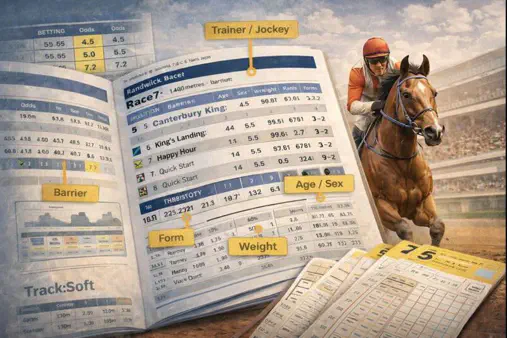
Australian race cards are organized into columns: horse name, barrier, jockey, trainer, weight, and a series of abbreviation columns that capture recent form, track condition, and speed figures. To read a symbol:
- Identify the column header (e.g., “Form” or “Pace”).
- Match the abbreviation with the glossary above.
- Note any accompanying numbers (e.g., “P5” means a pace rating of 5).
Many form symbols are tied to speed metrics, so after you’ve familiarized yourself with the basics, you might want to explore Pace Figures Explained: How to Read and Apply Speed Ratings in Australian Horse Racing for deeper insight.
Practical Example: Reading a Full Card from Start to Finish
Consider the following excerpt from a recent Melbourne race card:
| Barrier | Horse | Jockey | Form | Pace | Weight |
|---|---|---|---|---|---|
| 4 | Lightning Bolt | J. Smith | F A | P6 | 56kg |
| 12 | Storm Chaser | A. Lee | L B | P5 | 55kg |
- Form “F A” tells us the first start was a Faded finish, followed by an Appeared start with the horse finishing but not placing.
- Pace “P6” indicates a moderate early speed, suggesting the horse may have a comfortable finishing run.
By interpreting each symbol, you can gauge which horses are likely to improve or decline based on recent performance trends.
Tips to Avoid Common Misinterpretations
- Don’t assume “A” always means “Absent.” In Australian cards, “A” typically means the horse Appeared but was unplaced.
- Watch for context. A “B” in the ‘Form’ column refers to a Brought forward draw change, whereas a “B” in the jockey column signifies a Barnacle (a nickname for a jockey).
- Cross‑check speed figures. A low pace symbol (e.g., “P4”) combined with a strong finish may indicate a horse that thrives in slower races.
“Understanding the symbols on a race card is like learning a new language; once you’re fluent, the race becomes much clearer.” — Racing Analyst
“A solid grasp of form abbreviations turns raw data into actionable insight.” — Veteran Handicapper
Quick‑Reference Cheat Sheet for On‑the‑Fly Use
| Symbol | Meaning |
|---|---|
| A | Appeared (unplaced) |
| B | Brought forward (draw) |
| C | Claimed race |
| D | Disqualified |
| F | Faded |
| G | Gelding |
| H | Head margin |
| L | Leader |
| P | Pace figure |
| S | Spells |
| W | Weight carried |
When you’re at the track or scanning a card on your phone, keep this table handy to decode the most common symbols instantly.
Finally, once you feel comfortable with form symbols, broaden your view by learning how to read odds. A clear understanding of both form and pricing completes the toolkit needed for confident race day decisions. Check out How to Read Horse Racing Odds in Australia for the next step.